
Teaching reflections. Why do we need to recover imagination?
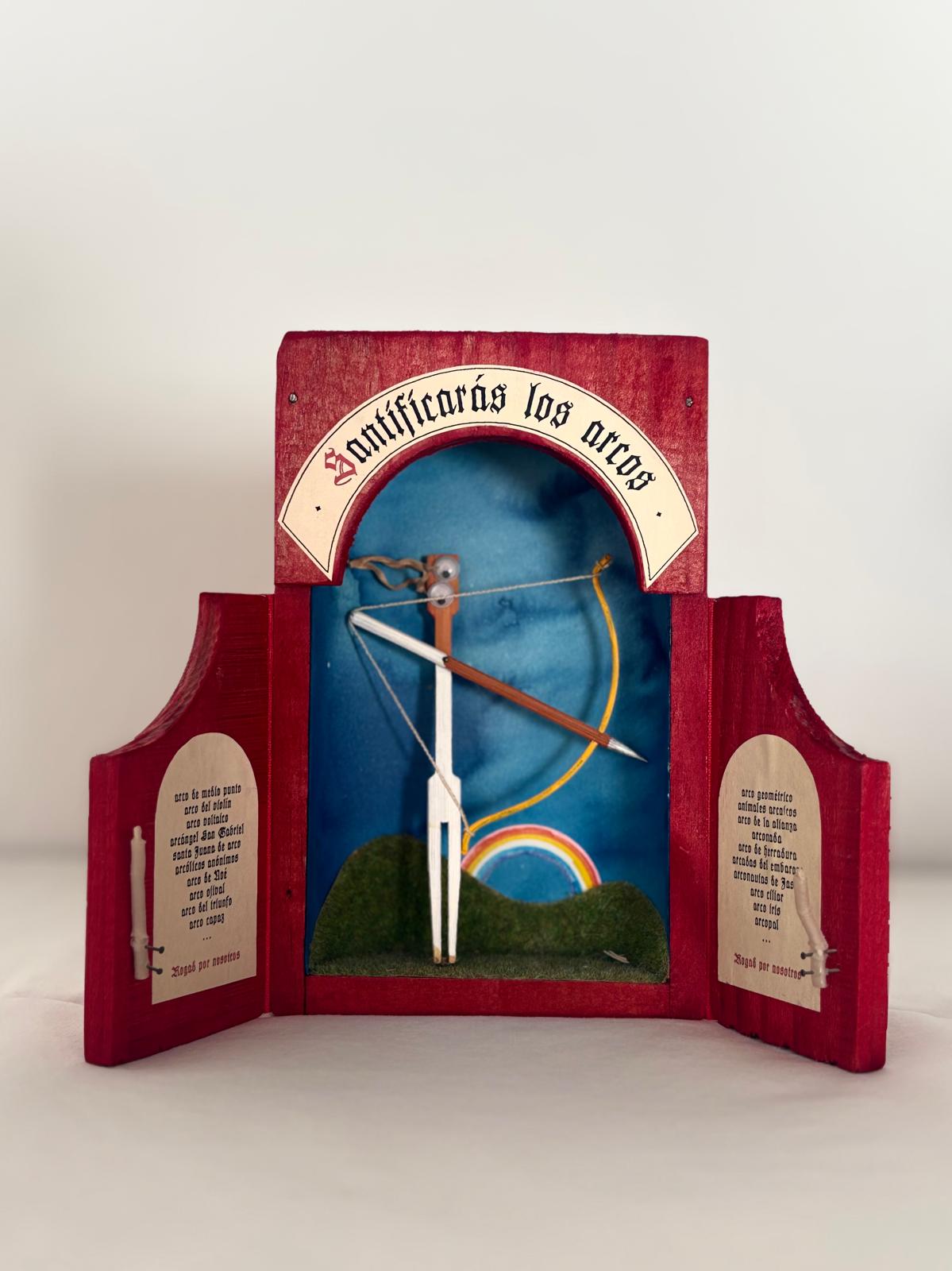
Commercial events, images turned into fast-consumption products, generic programming for all audiences, and an overloaded education system are formats that have become consolidated and have gradually displaced the essence of unpredictability. I have the feeling that ideas are repeating themselves and that surprise —which should be the driving force of culture and new thinking— is progressively being neutralised, until it becomes harmless and boring.
In this context, the focus shifts towards new technologies: to move forward, create new interests, generate interactive and immersive entertainment, and seek new formats.
But what if that is not the point? What if the goal is instead to shift perspective, to go back to the beginning, to the beginning of beginnings?
Why not recover the ability to think what does not yet exist, free our gaze from automatic repetition, open the way to forms of seeing that are not yet legitimised, and allow ourselves to be amazed by them?
Let us recover imagination.
I propose creating an uncomfortable, indeterminate space—open to the possibility of finding beauty in the monstrous, a place that enables rebellion against the “fake” and against this artificial nature dominated by a power we cannot control.
Imagining life cannot be a secondary exercise, but rather a way to broaden the horizon, to move beyond ourselves, to better understand what is not our own. This path is one of the challenges I set for myself in the classroom, and one I would love to extend elsewhere. Unlocking imagination, untying it, activating it, putting it into circulation—I am convinced this will allow us to begin again, to draw a singular idea that moves against habit.
Imagination does not appear on invoices, does not trade on the stock market, and yet it changes everything. It does not obey schedules, it is uncomfortable, it does not ask for permission, it slips into transitional practices and disrupts everything.
I almost never speak about imagination, nor about what I imagine; sometimes I allow myself, without many details, to share a fragment of a remembered dream.
Instead, for years I have kept hearing “creativity”, “the creativity”, “the creative”, “the creative (person)”.
This is not accidental, I suppose.
Creativity has become a productive, measurable, profitable value; a competence that remains within the limits of what already exists, a skill that responds to a specific demand—very capitalist and rather dull. (You can probably imagine what I think about artificial intelligence.)
Imagination, which I claim and offer, does not seek to escape reality (if such a thing exists), but to intervene in it. As Maxine Greene —teacher born in Brooklyn, philosopher and activist (I recommend Releasing the Imagination: Essays on Education, the Arts, and Social Change)— suggests, imagining is about opening the possibility for the world to be different. I want to try. The writings of Paulo Freire, Brazilian educator, encourage me to work towards a school that does not train creative individuals to adapt to the world, but subjects capable of imagining it differently and thus changing it.
Yes, I advocate for reactivating imagination and choose to understand creativity as a functional skill from which I want to distance myself.
The New Education movement, with figures such as John Dewey, Maria Montessori, Ovide Decroly, Célestin Freinet or Rosa Sensat, marked a fundamental shift in this direction. Learning becomes an active process of exploration and meaning-making. It is there that imagination finds its place, not as an accessory, but as a condition.
I recently came across Escola Imaxinada, which continues along this path. A project I follow, created by an educational innovation group with artists such as Vicente Blanco, Estella Freire and Salvador Cidrás. Highly recommended.
From time to time I think of Els Comediants, a radically free theatre collective that reimagined culture and traditions. The non-corporate world-building work of Marcel·lí Antúnez (who has collaborated with the school this year),
Joan Jonas, La Veronal, Carol Rama, Charles Chaplin, Louise Bourgeois or Björk illuminate me without abstraction, helping me change how I perceive the world and build other forms of reality.
I often keep matchboxes to turn them into flea houses, as they do at Circ Cric.
Perhaps, then, imagination can prevent me from becoming an algorithmic, bureaucratic and predictable extension. It becomes necessary in order to resist everything that tends to automate me.
Imagination —not creativity, nor artificial intelligence— will not optimise me. It will return to me that essential, fragile, unguaranteed space full of possibilities. It will help me stop producing, producing, producing; I will forget about performing well, and thus I will step outside the dominant discourse: because imagining is not useful, it is a profoundly transformative, collective, transparent and positive act.
Mònica López Dalmau
Teacher EADTarragona
Bachelor’s Degree in Communication (UOC)
Higher Technician in Artistic Photography
Master’s degrees in Exhibition Objects and in Urban Architectural Lighting
Email: monica.lopez@eadt.dipta.cat