
URV and Tarragona School of Art promote printmaking as an interdisciplinary educational tool

The Department of History and Art History at the Universitat Rovira i Virgili (URV), together with the Institute of Education Sciences and the Tarragona School of Art and Design (EADT), have developed the teaching innovation project Exlibris. Printmaking as a tool for interdisciplinary learning. This initiative has incorporated an artistic activity—printmaking—into the curricula of History, Art History, and Archaeology degrees, with the aim of merging theoretical knowledge with artistic practice.
The activity has been delivered by professors from both URV and EADTarragona, who have provided theoretical sessions in university classrooms complemented by practical workshops held in the artistic facilities of the Tarragona-based institution. This approach allows students to directly experience traditional printmaking techniques while deepening their understanding of related historical aspects.
Within the framework of the project, printmaking has been used to design exlibris—classic bookplates inserted into books to indicate ownership, also considered works of art. Students have explored various traditional graphic techniques to study historical typographic marks, applying this knowledge to the creation of exlibris inspired by different historical periods and stylistic traditions.
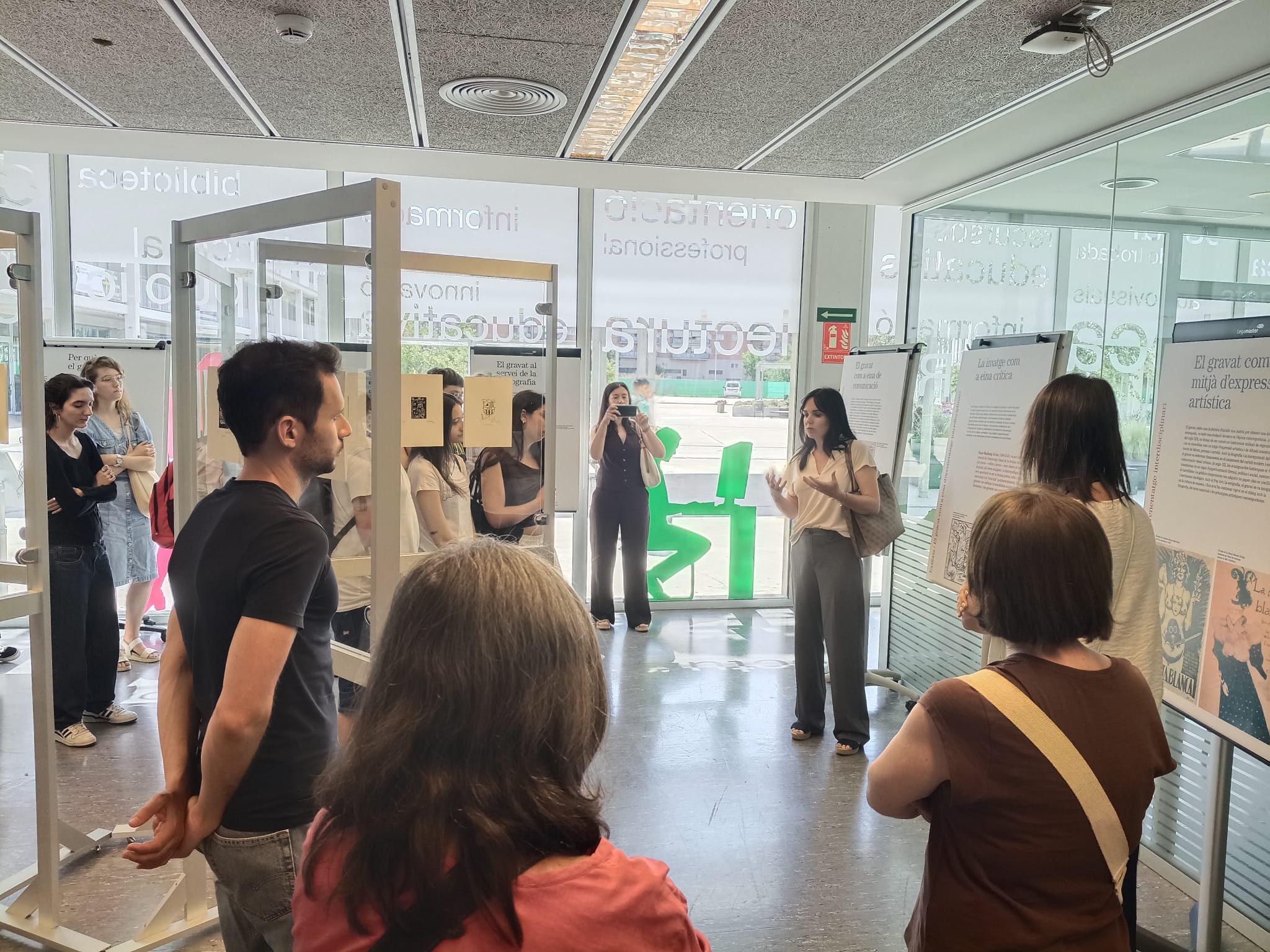
Exhibition at the CRAI of the Campus Catalunya
These final projects can currently be viewed in an exhibition that opened on Monday, June 8 at the CRAI, located on the Campus Catalunya. The opening coincided with the project’s closing event, during which the organisers presented the results obtained. Among them were José Ignacio Fiz, director of the Department of History and Art History; Marcel Blàsquez, director of the EADT; and Antoni Pérez-Portabella, director of the Institute of Education Sciences.
The team highlighted that “the project should become a benchmark experience in the field of teaching innovation and the humanities, and consolidate a stable line of collaboration between the university and the EADT”. This statement emphasises the intention for the initiative to serve as a pedagogical model within the university context.